
 NOTE: You do not have to read this entire document word-for-word! Please scroll to the sections that are most relevant to your needs.
UPDATE 6/10/2026: The D20 board added Policy ACA to the agenda the moment public comment sign-up opened, after we informed you all that it was not on the agenda for tomorrow’s meeting. This is clearly an attempt to silence community voice or discourage advocates. Sign up here to provide public comment.
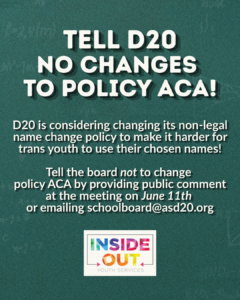
Hello! Thank you for your interest in advocating for Academy District 20 (D20) youth to have their identity affirmed in schools with no strings attached. The D20 Board of Education is updating their policy ACA to make it even more difficult for students to access rights they already have, the right for their chosen name to be used in school.
These changes would add another burden to LGBTQIA2+ young people being included and affirmed at school. Please join us on June 11th (details below under “meeting logistics”) to let the D20 Board of Education know their policy does not need to be changed. If you’re not already signed up for the activist network, sign up now to receive reminders by text.
If you can’t attend in person, please consider sending the board an email. Find email guidance and a template below under “email logistics”.
Click here to see D20’s current ACA, which we advocate for keeping in place!
Problems with Changing Policy ACA
Note: As of this writing (5/29/2026) D20 has not published their edited policy ACA, therefore we do not have the exact language of the policy. When we do, we will update this site with more specific language.
- Requiring parental consent will bar some students from their rights established in the Non-Legal Name Change law HB24-1039, and the Kelly Loving Act.
- How this is illegal: If a student requests a name change, but they are denied due to a lack of paperwork, the school deadnaming them purposely and consistently is still considered unlawful discrimination.
- The current policy is legally compliant, and in line with expert guidance on how to support students.
- The Board has signaled that this policy will only apply to trans and gender-expansive students’ chosen names, therefore singling out trans students. That is clear discrimination.
See these comments made by the D20 Board and Legal Counsel (Brad Miller) at the May 14, 2026 meeting:
Logistics
Meeting Logistics
D20 has verbally committed to moving forward with adding a parental consent requirement to Policy ACA. As of today (5/29/2026) D20 has not published an agenda for the June 11th meeting, but we plan to attend that meeting no matter what to make our voices heard on Policy ACA. When the agenda is published, we will include it here. You can also check here.
The meeting will be held on June 11th at 5 p.m. at the EAC, 1110 Chapel Hills Drive. To sign up for public comment, fill out this form between noon on June 10th and noon on June 11th. The earlier you sign up, the better! We want to fill public comment with voices supportive of trans students. Public comment is limited to two minutes, so be concise.
Know Before You Go: Safety and Comfort
- Raptor Security
- To attend this meeting, you must go through the Raptor Security system. This means your full, legal name will be recorded in D20’s systems.
- A nametag will be printed at the meeting with your full, legal name, which you are required to wear at the meeting.
- We understand there are risks to your full, legal name being recorded, including but certainly not limited to deadnaming. Please make the decision that is best for your safety and comfort.
- Legal risk
- In the past, director Derrick Wilburn has sued a parent for comments made during public comment. We caution you against making direct accusations or threats to the board members, as this could have legal consequences.
- Therefore, try to remain calm and collected when giving public comment, and stick to facts and personal experience.
- Environment
- Unlike some of the board rooms where we have mobilized, the D20 Board room is environmentally less welcoming; formal and tense. Be prepared for some physical discomfort.
- We also do not have LGBTQIA2+ allies on this board, so the board discussion may be more uncomfortable than activists are used to in D11 and D49.
- Due to the lack of allyship on the board (including some outright hostility), we anticipate they will vote to pass this more restrictive policy. Make plans to care for yourself before and after.
Scroll down to see the high-impact talking points we have created, which will give us the highest likelihood of influencing the board’s decision. The more people who show up, the more points we hit, and the more love we bring for trans students, the more likely it is we can change the Board’s mind.
Public Comment Testimony Outline:
Public comment in D20 is limited to 2 minutes. Make your comments concise to fit into the time limit.
Hi,
My name is ______, and I am a ____ (parent, teacher, student, community member etc.) I appreciate the opportunity to share my concerns regarding your updates to Policy ACA.
Opening Statement:
(State a clear and concise statement of your position and why it matters.)
Example: “Ensuring that all students, including LGBTQ youth, feel safe and supported in our schools is not just the right thing to do—it is essential for their well-being and academic success.”
Supporting Points (1-3 key arguments): Any of the talking points below can be used here, and personal stories are very impactful additions
- [First Point] – Provide a fact, statistic, or personal experience that supports your position.
- [Second Point] – Expand on another reason why this issue is important. This could include research, best practices from other districts, or legal considerations.
- [Third Point] (if applicable) – Address potential concerns and offer constructive solutions.
Personal Story (if applicable):
(Sharing a brief, relevant personal story can make your comment more compelling.)
Call to Action:
(In your own words, specifically state what action you want the board to take.)
Ex. I/We are asking you not to make changes to Policy ACA. If you must require contact with parents, please update the policy to notify the parents after a student comes forward, explicitly requiring that the student be informed before contacting parents or guardians.
Closing Statement:
(Thank the board for their time and reiterate the importance of your request.)
Example: “Thank you for your time and for your commitment to ensuring that all students have a safe and supportive learning environment. I hope you will take action to make our schools more inclusive for every student.”
Email Logistics
All board members are listed below. We recommend emailing the whole board at this email address: schoolboard@asd20.org
- Amy Shandy, President
- Susan Payne, Vice-President
- Holly Tripp, Treasurer
- Eddie Waldrep, Director
- Derrick Wilburn, Director
- Col. David Herndon, USAFA (Non-voting)
Email Template
An email is not subject to the same word limitation as a public comment, but make sure your email is neither too long nor too short.
Subject: Concerns on changes to policy ACA
Dear members of the District 20 School Board,
My name is ___, and I am writing to you as a _____ (your role, e.g., concerned community member, parent of a student, educator, etc.). I appreciate the opportunity to share my concerns regarding updates to Policy ACA.
At current, D20’s ACA policy is in alignment with state laws and protections. Updates to this policy will put students at risk for being denied access to their rights in our district.
Key Points: Any of our talking points below can be used, and personal stories are always a powerful addition
- [First Point] – Provide a fact, statistic, or personal experience that supports your position.
- [Second Point] – Expand on another reason why this issue is important. This could include research, best practices from other districts, or legal considerations.
- [Third Point] – Address potential concerns and offer constructive solutions.
Personal Story (if applicable): (Sharing a brief, relevant personal story can make your comment more compelling.)
Call to Action: (Specifically state what action you want the board to take.) Example: “I/We are asking you not to make edits to the current Policy ACA in the district. If you must require contact with parents, please update the policy to notify the parents after a student comes forward, explicitly requiring that the student be informed before contacting parents or guardians.”
Closing Statement: (Thank the board for their time and reiterate the importance of your request.) Example: “Thank you for your time and for your commitment to ensuring that all students have a safe and supportive learning environment. I hope you will take action to make our schools more inclusive for every child.”
Sincerely, (Your Name)
(Your Contact Information)
(Your Affiliation, if applicable)
Talking Points
Please choose the talking points that resonate with you, while including personal anecdotes you think would be powerful to share. Given the attitude of the Board, we think the talking points listed first will be the most effective, but a wide variety of responses from the community would show diverse reasoning behind our ask.
If you are interested in looking for other statistics to include in your communications, check out the Trevor Project or the Healthy Kids Colorado Survey.
- Trevor Project: https://www.thetrevorproject.org/survey-2025/
- Healthy Kids Colorado: https://cdphe.colorado.gov/hkcs
Our Ask
- “I/We are asking you not to make edits to the current Policy ACA in the district.”
Problems with legal counsel and board professionalism
- See the video above to hear the arguments board members are making for changing this policy. This shows they have little to no understanding about what is actually at stake, nor the laws that protect students in this area.
- This policy has nothing to do with religion or gender-affirming surgery, two of the biggest factors in board discussion thus far. Point this out as part of your comment.
- D20 board members are not medical professionals, nor is policy ACA about hormones or surgeries, and yet Waldrep and others are bringing up medical procedures as a way to invalidate the experiences of trans students. Focusing on surgery and HRT is an inappropriate overreach of the board’s role, and far outside the board’s expertise.
- Multiple members of the board are also insinuating that being trans is a sign of psychological distress or a “cry for help.” This shows a deep misunderstanding about the community about whom they are creating these policies.
- Brad Miller, D20’s new legal counsel, has a long history of:
- creating illegal anti-trans policy in hopes of getting a case to the Supreme Court. This is well documented (link, link, link, link)
- financial corruption, often leading to egregious legal fees, which negatively impact district finances (link, link, link, link)
- being kicked out of, or leaving, districts in a poor financial position. Most recently on May 22, 2026. Edit 6/4: Actually, most recently on June 2, 2026.
- It is deeply embarrassing that with Brad Miller’s history, the board still decided to appoint him. His appointment goes against their proclaimed values of financial responsibility and transparency, not to mention “excellence.”
- Brad Miller’s playbook is to get districts to make major changes at the district level, including firing superintendents, and the board played directly into that agenda by firing their own on May 19th.
Privacy & Student Rights
- Students have the right to share their identity with who they want when they want. Inserting the school or Board into those private conversations between families is not only unnecessary, but an overreach of schools into the home. The board has said the school should not be making decisions on a student’s identity, yet that is exactly what they’re doing. Not once have they acknowledged a student’s right to make their own decision about their own identity.
- HB-1039 is law in Colorado. It says that schools must use a student’s chosen name, which is not conditional on parental consent. Changing this policy to include parental consent or notification would put barriers in place for students to access rights they are already guaranteed. The Kelly Loving Act further solidifies these rights.
- This policy could bring legal problems for the district that may take time and attention away from other district priorities, of which there are many. It sends a clear message that trans students are not respected for who they are by board members supporting this policy.
- “Students do not shed their constitutional rights to freedom of speech or expression at the schoolhouse gate.”
-
- Tinker v. Des Moines Independent Community School District, 393 U.S. 503 (1969), was a landmark decision by the United States Supreme Court that recognized the First Amendment rights of students in U.S. public schools. The Tinker test, also known as the “substantial disruption” test, is still used by courts today to determine whether a school’s interest to prevent disruption infringes upon students’ First Amendment rights. The Court famously opined, “It can hardly be argued that either students or teachers shed their constitutional rights to freedom of speech or expression at the schoolhouse gate.”[1][2]
- Self-representation is a form of free speech. Representing one’s gender identity and the name that aligns with it should be protected as that student’s free speech. In fact, this is the opposite of a “substantial disruption.” It allows students to focus on school while knowing they are supported by the school staff around them.
Logistical Burden for Nicknames
- If edits to this policy include requiring parental consent, students will have to get consent from their parents any time they want to use a name other than their “legal name.” Depending on what steps teachers, administrators, students, and parents must go through, there may be hours of wasted time documenting and filing all of the nicknames, abbreviations, and shortened names (i.e. Mike for Micheal, Chrissy for Christina).
- If only transgender or gender non-conforming students are required to go through this process, they are being targeted due to their gender identity, which is an explicitly protected class in Colorado anti-discrimination law.
- If this implementation is intentional, it requires school personnel to determine themselves which names or nicknames are too different from their legal name to constitute an official ACA name change. This process would be arbitrary and potentially discriminatory.
- Ultimately, HB24-1039 requires students’ chosen names be used in schools. That is not contingent on paperwork filed or parental consent. If a student requests a different name and it is not used, D20 will be in violation of Colorado law. If students don’t fill out any paperwork, the district must still use their chosen name.
Accessibility
- LGBTQIA2+ students sometimes struggle in school due to a lack of feeling safe or respected. If a student has to worry about being bullied or harassed in the hallway, is dealing with vandalism of their personal belongings, or is forced to be in a classroom with teachers and peers who degrade them, they cannot focus on what they are there for, school.
- Using chosen names is an accommodation that creates an environment where students know they are protected from discrimination and allows them to succeed in school instead of being afraid to participate or show up at all.
Benefits of Affirming Environments
- 54% of transgender and nonbinary young people found their school to be gender-affirming, and those who did reported lower rates of attempting suicide.
- Schools with GSAs see students with better mental health and educational outcomes (whether they participate in the GSA, are LGBTQIA2+, or not) than schools without GSAs. Graduation rate, grades, and test scores can improve for all students when the expectation is that everyone is respected and protected.
- This speaks to the impact of inclusion on the well-being of everyone.
- LGBTQIA2+ students have reported significant stress and anxiety due to rhetoric like this from the national level down to their communities. Students pay attention to these conversations and know when they are not being respected by the adults making decisions about their lives.
- LGBTQ+ young people who reported living in very accepting communities attempted suicide at less than half the rate of those who reported living in very unaccepting communities.
Risks associated with outing students
- Only 40% of LGBTQIA2+ youth feel like they can be open in their identity at home. That is less than half. Over 1 in 2 situations where home is contacted based on this policy could potentially expose a student to an unsafe situation.
- If a student is unaware that home has been contacted, they may be unable to take steps to prepare or protect themselves if needed.
- LGBTQIA2+ youth are at higher risk of homelessness due to unaccepting families. If students feel safe to explore their identity at school but not at home, but are not given the agency to talk to their parents or guardians on their own timeline, this issue could potentially be exacerbated.
Benefits of having trusted adults in youth lives
- The benefits of having ONE trusted adult in an LGBTQIA2+ student’s life include
-
- At least a 40% decrease in the likelihood they will attempt suicide
- Only 63% of LGBTQIA2+ students in CO have an adult they can go to for help with a serious problem.
- Only 35% of LGBTQIA2+ students in CO feel their stress level is manageable most days.
- Teachers are often trusted adults for students experiencing hardship at home, this policy might make it harder, if not impossible, for them to express that support.
- If school personnel are barred from respecting a student due to an administrative barrier, they are effectively being barred from becoming trusted adults.
- If a student disclosing their identity to school personnel becomes a potential source of danger in school or at home, they may not reach out in the first place.
Negative Mental and Physical health outcomes that will be exacerbated by this policy.
- Transgender and gender non-conforming youth are at increased risk for many negative mental and physical health outcomes, including…
-
- Use substances as a coping mechanism, and develop an unhealthy relationship with substances
-
- Suffer sexual assault or harassment
-
- Experience bullying
-
- Experience homelessness or shelter insecurity
-
- Each of these are compounded by other systemic pressures, including racism and ableism.